As an Amazon Associate, I earn from qualifying purchases.
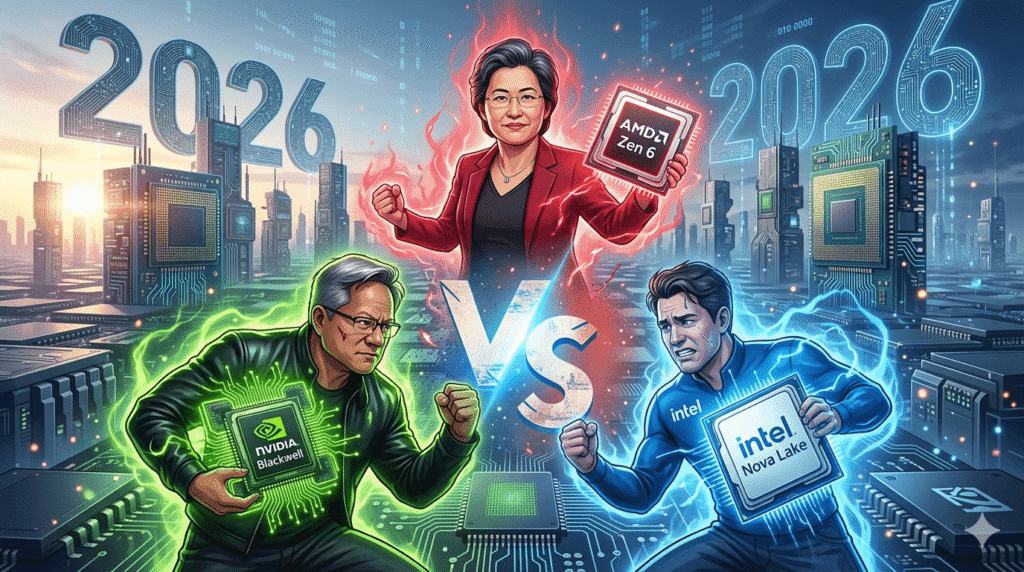
The semiconductor industry has always been a battlefield of innovation, but 2026 marks a historic turning point. As Artificial Intelligence (AI) transitions from a cloud-based luxury to a localized necessity, the “Big Three”—AMD, NVIDIA, and Intel—are locked in a high-stakes war for dominance.
For investors and tech enthusiasts, the central question is no longer just about who has the fastest chip, but who owns the AI ecosystem. With Lisa Su recently declaring that the CPU is back as a “Main Event,” the narrative is shifting.
1. AMD’s Masterstroke: Why the CPU is the “Main Event” Again
For the past few years, the spotlight was exclusively on NVIDIA’s GPUs. However, AMD CEO Lisa Su has pivotally reframed the conversation. In recent keynotes, she emphasized that while GPUs handle massive training tasks, the CPU is the brain that manages the complex orchestration of AI tasks in daily computing.
The Rise of the AI PC
AMD’s Ryzen 9000 series (Zen 5 architecture) and the upcoming Zen 6 are not just incremental upgrades. They represent a fundamental shift toward AI PC integration. By embedding powerful Neural Processing Units (NPUs) directly into the CPU, AMD is enabling users to run complex AI models locally on their MacBooks or PCs without relying on the cloud.
Server Dominance: EPYC vs. Xeon
In the data center realm, AMD’s EPYC processors have achieved what was once thought impossible: parity with, and in some metrics, superiority over Intel’s Xeon. By offering more cores and better energy efficiency, AMD has captured nearly 30-40% of the server market, a trend that continues to accelerate in 2026.
2. The Competitive Landscape: AMD vs. The Giants
AMD vs. Intel: The Battle for the PC Soul
Intel is currently in a “Turnaround Era.” While they still hold the majority of the laptop market, their struggle with manufacturing nodes has allowed AMD to seize the high-end gaming and professional workstation segments.
- The Verdict: Intel is betting big on its foundry services and government subsidies (CHIPS Act). However, in terms of architectural efficiency, AMD’s Zen 5 and Zen 6 currently hold the “performance-per-watt” crown.
AMD vs. NVIDIA: The Software Moat
NVIDIA remains the undisputed king of AI training thanks to CUDA, their proprietary software platform. However, AMD is attacking this “moat” through the ROCm 7.0 open-source ecosystem.
- The Verdict: While AMD’s MI350X hardware is a beast that rivals NVIDIA’s Blackwell architecture in memory capacity, NVIDIA’s software ecosystem remains a formidable barrier. AMD isn’t necessarily trying to “kill” NVIDIA; they are positioning themselves as the only viable, high-performance alternative for companies that want to escape NVIDIA’s pricing monopoly.
3. Investment Analysis: Where Should You Put Your Money?
Deciding where to invest requires looking at the risk-to-reward ratio of each titan.
NVIDIA: The Blue-Chip Growth Play
NVIDIA is the “standard.” Investing in NVIDIA is a bet on the continued expansion of the global AI infrastructure.
- Pros: Massive margins, total market dominance, and an incredible software ecosystem.
- Cons: Extremely high valuation. The market expects “perfect” results; any slight miss could lead to volatility.
AMD: The Momentum & Market-Share Play
AMD is the “growth challenger.” They are successfully stealing market share from Intel in CPUs and providing a “safety valve” for the AI GPU market.
- Pros: Diversified revenue (Gaming, PC, Server, AI), exceptional leadership under Lisa Su, and a clear roadmap for Zen 6.
- Cons: They must consistently execute on both the CPU and GPU fronts simultaneously, which is a massive engineering feat.
Intel: The Value & Recovery Play
Intel is for the patient investor.
- Pros: Deeply undervalued compared to peers, strategic importance to the U.S. government, and potential as a global foundry leader.
- Cons: High execution risk. If their 18A process node fails to deliver, the recovery could take years.
4. The Path to Retirement: A Strategic Portfolio Approach
For a 50-year-old investor planning for a comfortable retirement by age 67, stability and growth must be balanced. Relying on a single stock is risky. A smarter approach often involves a “Core and Satellite” strategy.
- Core: Broad market exposure through ETFs like QQQM (Nasdaq 100) or SPLG (S&P 500).
- Satellite: Individual picks in the semiconductor space.
- If you seek high-octane growth: NVIDIA/AMD.
- If you seek dividend-growth stability: SCHD (which often holds mature tech names) or Broadcom (AVGO).
Conclusion: The New Triumvirate
The semiconductor world is no longer a monopoly or even a simple duopoly. It is a complex ecosystem where AMD has proven it can fight on two fronts and win. By focusing on “AI everywhere”—from the pocket-sized laptop to the massive data center—AMD has secured its place as a cornerstone of the future economy.
Whether you are a retail investor using Robinhood or a professional analyst, one thing is clear: the chips powering our world are the new oil. And in this race, the “Main Event” has only just begun.
Update: Insights from the Latest Earnings Call
During the most recent earnings call, Dr. Lisa Su provided a bullish outlook on the company’s AI trajectory. She noted that the MI300X accelerator is the fastest-ramping product in AMD’s history, signaling strong adoption by cloud giants like Microsoft and Meta. Furthermore, she reinforced the “AI PC” era, stating that AI capabilities will soon be a standard requirement for all premium computing. This shift positions AMD’s integrated CPU+NPU architecture as the primary engine for the next decade of personal and enterprise computing.
Disclaimer: This article is for informational purposes only and does not constitute financial advice. Always consult with a professional before making investment decisions. This post contains affiliate links; we may earn a commission at no extra cost to you.