As an Amazon Associate, I earn from qualifying purchases.
📢 Update (April 28, 2026): Regarding the recent reports mentioned in this article about OpenAI’s revenue targets, OpenAI has officially refuted these claims. In the fast-moving tech sector, information often evolves rapidly. This article remains focused on the core principles of long-term retirement portfolio management and the importance of maintaining discipline despite market noise and shifting news cycles.
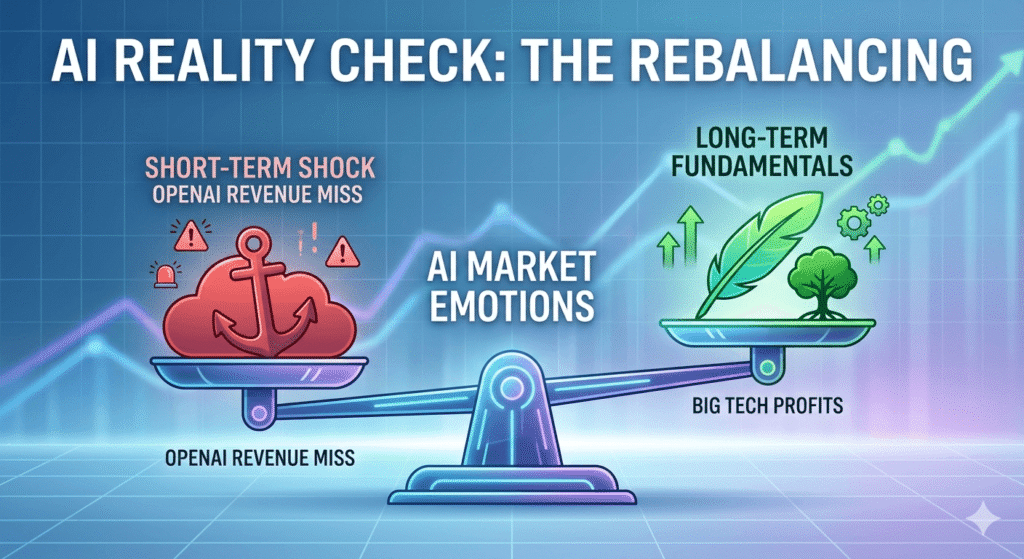
As of April 28, 2026, the financial headlines are dominated by a single story: OpenAI has missed its internal revenue and user-growth targets. For the tech-focused investor, this news has sent a ripple of anxiety through the markets, reigniting the age-old debate: Is the AI bubble finally beginning to deflate?
If you are managing your own retirement account, headlines like these can be unsettling. You might find yourself wondering if your tech-heavy ETFs or individual stock picks are in danger. However, as investors, it is vital to distinguish between a “market correction” and a “market collapse.”
In this article, we will analyze the recent OpenAI news, what it signals for the broader AI sector, and, most importantly, how you can adjust your retirement strategy to stay the course without losing sleep.
Decoding the News: Growing Pains vs. Structural Failure
The recent report from The Wall Street Journal suggests that OpenAI has struggled to hit its ambitious targets for weekly active users and monthly revenue. Additionally, internal concerns regarding the massive costs of computing power have come to light.
Why the Market Reacted
Markets function on the fuel of “expectations.” When companies like OpenAI set aggressive growth targets, the entire AI ecosystem—including chipmakers like Nvidia and ARM, and cloud providers like Microsoft—prices those expectations into their stock valuations. When those targets are missed, the market experiences a “valuation adjustment.”
Is the AI Revolution Over?
Not necessarily. It is important to remember that AI is in a transitional phase. We are moving from the “Hype Phase”(where investment is driven by what could be) to the “Integration Phase” (where businesses are trying to figure out how to make money from it).
Revenue misses in a nascent industry are often less about the failure of the technology and more about the challenge of scaling enterprise adoption. The technology works; the business models are simply taking longer to mature than investors hoped.
The Retirement Investor’s Guide to Managing Volatility
If you are investing for retirement, your time horizon is not measured in days or quarters—it is measured in decades. While the recent news regarding OpenAI might cause short-term volatility in tech stocks, it does not necessarily change the long-term thesis of the digital age.
Here is how to protect your portfolio while the market navigates this “reality check.”
1. Don’t Let FOMO Dictate Your Asset Allocation
The most common mistake investors make during an AI boom is over-concentration. If you find that your retirement portfolio has become “Tech Heavy” simply because those stocks performed well over the last two years, you are holding a ticking time bomb of volatility.
- The Solution: Rebalance. If your portfolio has drifted away from your target asset allocation (e.g., 60% stocks, 40% bonds), sell a portion of your winners and buy into underperforming sectors. This isn’t just about safety; it is the mathematical equivalent of “buying low and selling high.”
2. Focus on the “Quality” Factor
In the early days of a market boom, every company gets a lift. As the market matures—as we are seeing now—investors become more selective. They stop rewarding “ideas” and start rewarding “cash flow.”
When looking at your holdings, ask yourself:
- Does this company have a strong balance sheet?
- Do they have a history of generating free cash flow?
- Are they essential to the infrastructure, or are they just “AI-adjacent”?
Focusing on quality companies that can survive a period of lower growth is the ultimate hedge against market uncertainty.
3. Maintain Your Cash Buffer
For retirees or those within ten years of retirement, a cash buffer is the most powerful tool in your arsenal. If you hold 1–2 years of living expenses in cash or short-term, high-yield instruments, you never have to sell your growth stocks during a market dip to pay your bills. You can simply hold your positions and wait for the market to normalize, effectively “outwaiting” the volatility.
4. Stay Disciplined with Dollar-Cost Averaging (DCA)
If you are still in the accumulation phase, market corrections are your best friend. A dip in the price of high-quality tech stocks allows your automatic contributions to buy more shares. Over the long run, consistent buying during periods of “market disappointment” often leads to superior returns compared to trying to time the market perfectly.
Is the “AI Bubble” Like the Dot-Com Crash?
This is the question on everyone’s mind. While there are similarities in the enthusiasm, the fundamental differences between 2000 and 2026 are stark.
- Then: Companies were burning cash with no path to profitability.
- Now: The “Big Tech” companies leading the AI charge are among the most profitable in history. Their core businesses (cloud, search, software, chips) provide a massive cushion of cash to fund their AI experimentation.
The current volatility is a test of confidence. It is a transition from speculative excitement to industrial reality.
The Bottom Line: Keep Your Eyes on the Horizon
OpenAI missing its revenue targets is a headline, not a catastrophe. It serves as a reminder to all of us that even in a technological revolution, business growth is rarely a straight line.
As a prudent investor, your goal is not to chase every headline or react to every quarterly report. Your goal is to build a portfolio that can weather the storm. By focusing on diversification, maintaining a cash buffer, and holding high-quality assets, you are well-positioned to ride out the noise and focus on what really matters: your long-term path to retirement.
What is your reaction to the latest market news? Are you planning to hold your tech positions, rebalance, or wait for more clarity? Share your thoughts in the comments below!
Disclaimer: This blog post is for informational purposes only and does not constitute professional financial advice. All investing involves risk, including the loss of principal. Please consult with a qualified financial advisor regarding your personal financial situation before making any changes to your investment portfolio.