As an Amazon Associate, I earn from qualifying purchases.
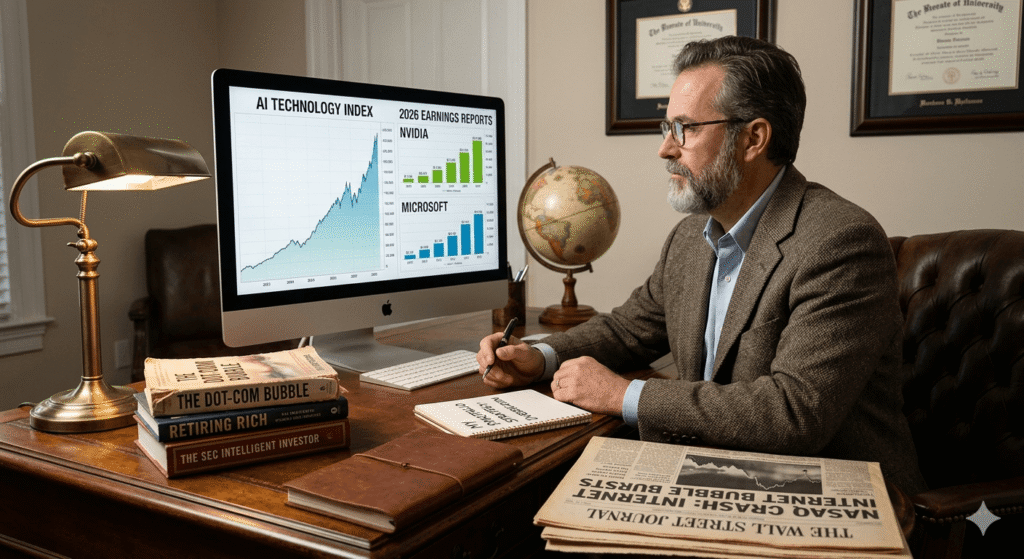
The financial world is currently obsessed with one burning question: Is the current AI stock boom just a replay of the devastating 2000 Dot-com bubble, or is this something fundamentally different?
For those of us managing retirement portfolios, this is more than just a theoretical debate. It is a question of asset protection, risk management, and the difference between a comfortable retirement and a financial setback. If you are worried that today’s high-flying tech stocks might be a house of cards waiting to collapse, you are not alone.
The Bubble Debate: AI vs. The Dot-Com Era
To understand if we are in a bubble, we must look at the historical context. In 1999 and early 2000, the Dot-com bubble was fueled by “eyeballs” and “clicks.” Companies with no revenue, no profit, and often no business plan were trading at astronomical valuations simply because they had “.com” in their name. When the reality of earnings caught up with the hype, the crash was catastrophic.
The Fundamental Difference: Real Earnings vs. Speculative Hope
The primary argument against comparing today’s AI boom to the 2000 bubble lies in fundamental value. Unlike the internet companies of the late 90s, today’s AI leaders—companies like NVIDIA, Microsoft, Alphabet, and ARM—are among the most profitable enterprises in human history. They are not selling dreams; they are selling infrastructure, cloud capacity, and tangible productivity gains.
- 1999: Speculation was driven by possibility.
- 2026: AI growth is driven by capital expenditure and enterprise adoption.
However, this does not mean the market is immune to correction. When stock prices rise faster than earnings, they become susceptible to “valuation compression.” If AI companies fail to meet the lofty growth expectations priced into their current stock levels, a correction is inevitable.
“Am I Stupid for Not Investing in AI?” – Addressing the FOMO
The Fear of Missing Out (FOMO) is a powerful, dangerous emotion. When you see headlines of AI stocks soaring 20%, 50%, or 100%, it is natural to feel like you are being left behind.
But for an investor focused on retirement, you are not “stupid” for being cautious. In fact, you might be the smartest person in the room. Professional investing is not about catching every hype cycle; it is about managing risk and compounding wealth over decades.
If your portfolio is diversified across various sectors—healthcare, consumer staples, financials, and yes, technology—you are invested in AI. You are likely holding broad-market index funds or ETFs that already include heavy weights of the major AI players. You don’t need to bet the farm on a single tech stock to capture the upside of the AI revolution.
Disaster-Proofing Your Retirement Account: How to Handle a Crash
If you are concerned about a potential market “bubble burst,” the worst thing you can do is react out of fear by panic-selling or by avoiding the market entirely. Instead, use a structured approach to prepare your retirement accounts for volatility.
1. Reassess Your Asset Allocation
When markets are hot, your portfolio often drifts. A 60/40 stock-to-bond allocation might drift to 80/20 because the stocks (especially tech stocks) have outperformed. Use this time to rebalance. Sell some of your winners to lock in gains and buy assets that are currently underpriced or provide stability, such as high-quality bonds or dividend-paying stocks. This automatically forces you to “sell high and buy low.”
2. Build a “Cash Buffer”
For retirees or those nearing retirement, a cash buffer is your greatest psychological tool. If you hold 1–2 years of living expenses in a high-yield savings account or money market fund, you won’t be forced to sell your stocks during a market downturn. You can let the market recover while you live off your cash, bypassing the need to “lock in” losses.
3. Stick to Dollar-Cost Averaging (DCA)
If you are still in the accumulation phase, a crash is actually your friend. By continuing your automatic contributions, you are buying more shares when prices are low. Over a 10- or 20-year horizon, these “crashes” are merely blips on the chart. Dollar-cost averaging removes the emotional burden of trying to time the market.
4. Focus on Quality, Not Just Hype
Instead of chasing small-cap AI startups that have yet to prove their business model, tilt your portfolio toward “Quality” factors. Look for companies with strong balance sheets, high free cash flow, and a history of dividend growth. These companies are generally more resilient when speculative bubbles burst.
The Bottom Line: Discipline Beats Hype
The AI era is likely to be a long-term transformative period for the global economy, much like the introduction of electricity or the internet. However, market prices often get ahead of economic reality.
As you plan your retirement, do not let the noise of the market distract you from your primary goal: consistent growth and capital preservation. You don’t need to be an AI stock picker to be successful; you just need to be a disciplined investor.
If the market crashes, view it as a stress test for your portfolio. If you have built a diversified strategy and maintained your cash reserves, you will have the confidence to stay the course while others are panic-selling.
What is your approach to the current AI market? Are you increasing your exposure or sticking to your core strategy? Share your thoughts below and let’s keep the conversation going.
Disclaimer: This article is for informational purposes only and does not constitute financial advice. All investments involve risk, including the loss of principal. Consult with a qualified financial advisor before making significant changes to your retirement strategy.