As an Amazon Associate, I earn from qualifying purchases.
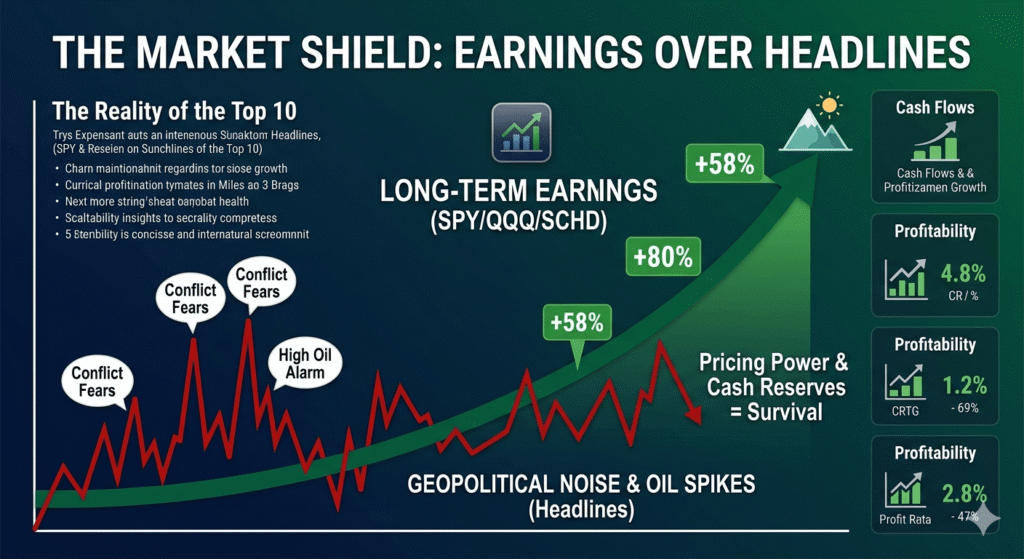
As a business owner, I have learned that there is one thing markets hate more than bad news: uncertainty. When headlines flash reports of conflict, such as the rising tensions between the U.S. and Iran, the first thing every investor feels is a twinge of anxiety. When those tensions threaten to disrupt global energy supplies and send oil prices skyrocketing, that anxiety often turns into a desire to sell.
But let’s pause and apply the same logic we use to run a business. If a supplier of yours faces a temporary disruption, do you shutter your company, sell your equipment, and quit? Of course not. You assess the impact, adjust your margins, and keep the business running.
Investing for retirement is no different. Whether it is a conflict in the Middle East or an energy crisis, these are “headline risks.” While they cause short-term market volatility, they rarely change the fundamental trajectory of high-quality companies over the next 17 years. Let’s look at how we navigate this environment without compromising our long-term goals.
The Macro Pressure: Why Oil Prices Matter
It is important to acknowledge why the market reacts so negatively to high oil prices. Oil is not just a commodity; it is the bloodstream of the global economy. When energy prices rise, three things happen:
- Margin Squeeze: For most companies, energy is a significant input cost—whether for transportation, manufacturing, or data center cooling. If a company cannot pass these costs on to the consumer, its profit margins shrink.
- Inflationary Pressure: High oil prices are the fastest way to spike the Consumer Price Index (CPI). This forces central banks to keep interest rates higher for longer to tame inflation, which makes borrowing more expensive for businesses and reduces the present value of future corporate earnings.
- Consumer Sentiment: When households pay more at the pump, they have less disposable income for discretionary spending—like buying a new iPhone, subscribing to streaming services, or eating out. This dampens the revenue growth for the companies we own.
It is logical for the market to dip when these fears arise. It is the collective “worry” of millions of investors being priced into the stock market in real-time.
The “Earnings” Shield: Why Market Leaders Prevail
Now, the big question: Can strong earnings overcome negative geopolitical news?
The answer is a resounding yes, provided you own the right companies. In the short term, markets move based on emotion. In the long term, they move based on earnings.
Look at the giants that dominate the S&P 500 (SPY) and Nasdaq 100 (QQQ). Companies like Microsoft, Apple, and Google are not just businesses; they are monopolies of the modern age. They possess Pricing Power—the ability to raise prices without losing customers.
When energy costs rise, these companies don’t panic. They absorb the costs, they innovate to become more efficient, and they continue to grow. Because they have massive cash reserves and dominant market positions, they are the first to recover when the geopolitical noise dies down. While a small, speculative stock might collapse during an oil crisis and never recover, the giants simply “take a breath.” They have the financial resilience to wait out the storm, and that is why they continue to lead the market, year after year.
The Business Owner’s Action Plan
When the headlines get loud, the rational investor gets quiet. As someone planning to retire in 17 years, I look at market volatility caused by oil price spikes as a “stress test” for my portfolio. Here is how I manage it:
1. Stay Invested in the “Core”: I do not try to time the market by exiting when news gets bad. History shows that the best days in the market often occur shortly after the worst days. If you are on the sidelines trying to avoid the “war dip,” you are almost guaranteed to miss the inevitable recovery.
2. Use Volatility to Rebalance: This is where the discipline comes in. If a geopolitical shock sends the market down, your portfolio’s asset allocation may drift. If your energy-heavy assets have gone up while your tech-heavy assets have gone down, the market is giving you a signal. It’s time to rebalance. Sell the winners, buy the foundation, and keep your 80/20 ratio intact.
3. Focus on Cash Flow: This is why I hold SCHD. Companies that have a track record of paying dividends are usually the most operationally efficient companies in the world. They have been through wars, oil shocks, and recessions before, and they keep paying. They provide the stability that allows me to sleep at night while the world news channels panic.
The Long-Term Perspective
If you are worried that a conflict or an oil price spike will ruin your retirement plan, you need to revisit your time horizon. Are you investing for next month, or are you investing for 17 years from now?
The energy markets will fluctuate. Geopolitics will always be messy. But the march of human innovation and the compounding power of the world’s most profitable companies are constants.
As a business owner, I don’t look at a temporary spike in oil prices and change my entire five-year plan. I shouldn’t do it with my portfolio, either. We are not looking for a “win” against the headlines. We are looking for the “win” of consistency, systematic buying, and the patience to let the market leaders do what they do best: compound capital.
Keep your eyes on the business, not the ticker. Your path to retirement is built on the fundamentals of the companies you own, not the volatility of the daily news cycle.
Disclaimer
The information provided on Smart Path to Retire is for educational and informational purposes only and does not constitute professional financial, investment, or legal advice.
As a business owner sharing my personal journey toward retirement, the strategies and asset allocations discussed here reflect my own opinions, risk tolerance, and research. They are not intended to be—and should not be interpreted as—financial advice or a recommendation to buy or sell any specific securities (including SPY, QQQ, SCHD, or any energy-related sectors).
- Investment Risk: All investing involves risk, including the possible loss of principal. Markets are volatile, and past performance is never a guarantee of future results.
- Do Your Own Research (DYOR): Every individual’s financial situation, goals, and risk tolerance are different. You should conduct your own due diligence and consult with a qualified financial advisor, tax professional, or accountant before making any investment decisions.
- No Guarantees: Any mention of specific returns, financial goals, or growth projections is purely illustrative and based on historical data or personal planning. No specific financial outcome is guaranteed.
By using this website, you acknowledge that you are responsible for your own financial decisions. The author of Smart Path to Retire shall not be held liable for any losses or damages resulting from the use of, or reliance on, the information provided on this site.