As an Amazon Associate, I earn from qualifying purchases.
We live in a world that respects the process of preparation. To become a lawyer, we spend years in classrooms and countless hours studying case law. To become a master carpenter or a skilled engineer, we dedicate years to apprenticeships and technical training. We understand, intuitively, that high-level outcomes require high-level preparation. We wouldn’t dream of performing a medical surgery or building a skyscraper without years of rigorous training.
Yet, there is one area of our lives where this logic completely falls apart: Personal Investment.
As a business owner who has managed a company for over a decade, I see a fascinating paradox. Most people spend 20-plus years of their lives preparing for a career, building the skills necessary to earn a living. But when it comes time to invest that hard-earned capital—the very fruit of those 20 years of labor—the same people often jump in with almost zero preparation. They rely on “hot tips,” emotional reactions to news headlines, or the latest buzz on social media.
Why do we treat our career as a serious profession, but treat our wealth management like a hobby—or worse, a gamble?
The CEO’s Duty: Treating Capital as a Business
I manage a team of six employees. In my business, I don’t make decisions based on what a neighbor thinks or what a shouting head on the evening news claims. I make decisions based on data. I look at the P&L (Profit and Loss) statements, I track cash flow, and I analyze efficiency. If I ran my business the way most people manage their stock portfolios—reacting to every minor tremor in the market—I would have been out of business ten years ago.
Investing is not about “guessing” where the market will go tomorrow. Investing is the act of allocating capital to systems that generate value. It is, quite literally, the ultimate business. As an individual investor, you are the CEO of your own financial future. Your fiduciary duty is not to a boss or a client, but to your future self and your retirement goals. If you aren’t applying the same rigorous due diligence to your portfolio that you would to a business investment, you aren’t investing; you are speculating.
The Power of Numbers: Why I Trust Data Over Noise
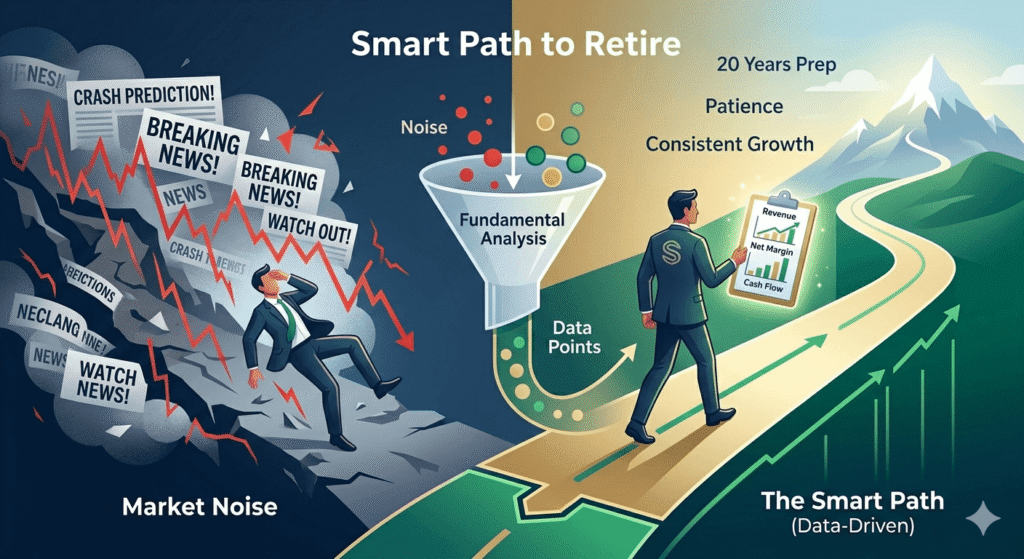
The market is designed to be noisy. Every day, there is a new crisis. Whether it’s geopolitical tension, interest rate fluctuations, or vague predictions about the economy, the market is a cacophony of sound. If you listen to the noise, you will be paralyzed. You will constantly be tempted to buy at the top because of “hype” or sell at the bottom because of “fear.”
My philosophy is simple, yet it has kept me steady for years: I don’t trust the news; I trust the numbers.
I am a fundamental investor. My strategy is built on the belief that while the market can be irrational in the short term, it is a weighing machine in the long term. It eventually forces the price of an asset to align with its actual performance. When I evaluate an investment, I strip away the headlines. I don’t care about the sensationalist “sky is falling” articles. Instead, I look for the bedrock of business health:
- Consistent Revenue Growth: Are people actually buying what this company (or ETF) is selling? Is the demand sustainable?
- Operating Margins: Is the organization efficient? Can it turn those sales into real profit, or is it burning cash?
- Cash Flow: This is the ultimate test. Does the company actually generate cash? As the saying goes, “Revenue is vanity, profit is sanity, but cash is king.”
When the market dips—and it will—I don’t panic. I look at the numbers. If the fundamentals are strong, if the earnings are growing, and if the cash flow remains robust, I don’t see a “crash.” I see a sale. I see an opportunity to acquire more of an asset that has proven its value. That is the luxury of a data-driven mindset. It turns market volatility into a friend rather than an enemy.
The “Smart Path” to Retirement
We are all walking toward retirement. For some, it is a foggy road filled with anxiety about what the market might do. For those who study, prepare, and commit to a data-driven strategy, it is a “Smart Path.”
Preparation isn’t just about reading a book; it’s about building a framework. It’s about understanding that you are not just buying a “ticker symbol”—you are buying a piece of a business or a collection of businesses that are working for you. When you view your portfolio through the lens of a business owner, you stop seeing volatility as a threat and start seeing it as the price of admission for long-term compounding.
Conclusion: Become a Student of Your Own Wealth
You’ve already proven you can master complex skills. You’ve navigated the professional world, built careers, and managed responsibilities. Don’t shortchange yourself when it comes to your investments.
Start treating your portfolio with the same respect you treat your professional life. Move away from the “get rich quick” mentality and embrace the “get rich sure” mentality. Stop listening to the noise and start analyzing the numbers. When you base your decisions on the cold, hard reality of financial performance rather than the emotional highs and lows of the news cycle, you will find a level of peace—and profitability—that most people never achieve.
The numbers are there, waiting to be read. Are you ready to do the homework?
Disclaimer: I am not a financial advisor. This is a personal strategy based on my specific business situation and risk tolerance. Every investor’s journey is unique, and you should adjust these allocations to fit your own financial goals. Please conduct your own research before making financial decisions.