As an Amazon Associate, I earn from qualifying purchases.
For a long time, I treated retirement planning like a heavy box I didn’t want to open. I knew it was important, but the financial jargon, the endless forms, and the fear of making the “wrong” choice made it feel overwhelming. It was easier to ignore than to face.
But as a small business owner in my 50s, I realized that procrastination is the most expensive cost of all. Time is the only asset we cannot earn back. I finally decided to stop reading about retirement and actually start preparing for it. Opening a Roth IRA was the first step on my 17-year journey to retirement, and I was shocked to find that the process was actually… surprisingly easy.
If you’ve been putting this off, this post is for you. Here is the simplest, no-nonsense way to get your first retirement account running, even if you’ve never invested a dollar in your life.
Step 1: Pick Your “Home Base”
The “best” account isn’t the one with the most complex tools; it’s the one you actually feel comfortable logging into. If a platform is too complicated, you won’t use it.
I’ve explored a few platforms, including various brokerage firms. Personally, I found Robinhood to be the most intuitive and user-friendly for a beginner. The interface is clean, the process is streamlined, and it doesn’t overwhelm you with complicated financial jargon. For a busy business owner, simplicity is a feature, not a bug.
- Pro Tip: If you choose a platform like Robinhood, look for features like the IRA match—it’s a small bonus, but it’s essentially “free money” for taking the first step.
Step 2: The 15-Minute Setup
You don’t need a degree in finance to get started. Go to the website or app, click “Open an Account,” and select “Roth IRA.” Have these three things ready:
- Your Social Security Number (SSN): Required for tax identification.
- Your Driver’s License/ID: Standard identity verification.
- Your Bank Account & Routing Number: To fund your future.
That’s it. You’ll answer a few simple questions, confirm your identity, and link your bank account. It takes less time than a lunch break.
Step 3: The Most Important Part—Don’t Stop at “Depositing”
This is where most beginners get stuck. There is a massive, life-changing difference between funding your account and investing your money.
- Funding: This is just transferring money from your bank to your Roth IRA “bucket.” It sits there as cash, earning almost nothing.
- Investing: This is the act of using that money to buy assets—stocks, bonds, or funds—that have the potential to grow.
If you don’t take the second step, your money is just sitting idle. You must log in, search for an investment, and hit “Buy.” Don’t let your money suffer from “cash drag”—put it to work.
My First Investment: Keep It Simple
If you aren’t sure what to buy, don’t try to pick individual “hot stocks.” That’s a recipe for stress, not retirement. Instead, look for these two “set-it-and-forget-it” options:
- Target Date Funds: These are the ultimate “hands-off” tools. You pick the year you want to retire (e.g., 2040), and the fund automatically adjusts the risk for you as you get closer to that date. It’s a portfolio managed by professionals.
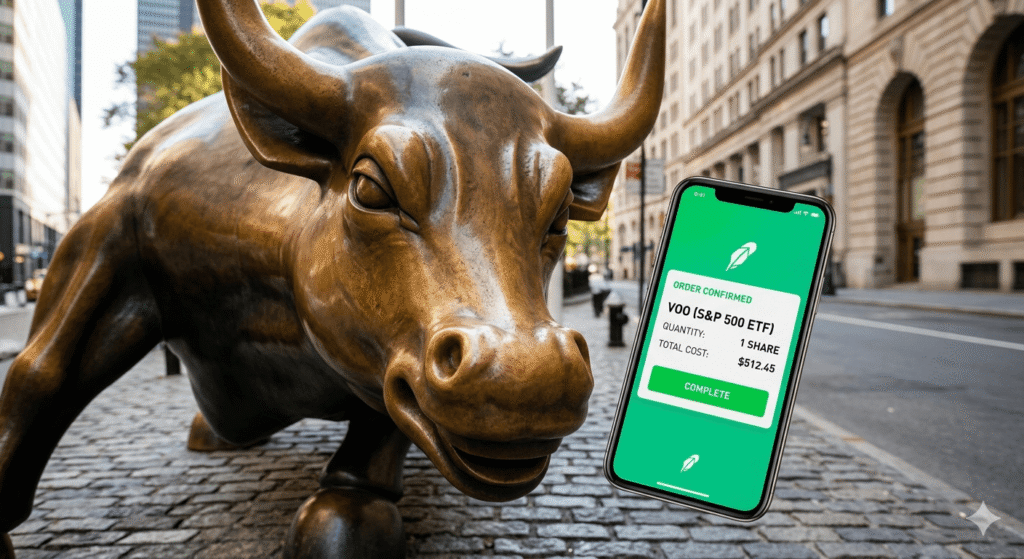
- S&P 500 Index Funds (like VOO): This is a simple way to own a small piece of the 500 largest, most established companies in the U.S. It is the “gold standard” for long-term growth and requires zero daily management.
The Psychology of Momentum
The hardest part of retirement planning isn’t the math—it’s the start. We tell ourselves we need to “wait until we have more money” or “wait until the market is better.” Stop waiting.
Once you open that account and see your first contribution—even if it’s just $50—the “what-if” fear disappears. It is replaced by a sense of control and intentionality. You are no longer just a dreamer; you are a builder. You are building the foundation for your 67-year-old self.
Frequently Asked Questions (FAQ)
Q: Is it really that easy to lose money? A: Investing involves risk, but the biggest risk in your 50s is not investing. By using diversified funds (like the S&P 500), you aren’t betting on one company; you are betting on the growth of the broader economy.
Q: Can I change my investments later? A: Yes. You can change your mind and sell/buy different funds within your Roth IRA whenever you want, without tax consequences (as long as you keep the money inside the account).
Q: Does Robinhood charge fees? A: Most modern platforms have removed trading commissions. Always read the fine print, but for standard index investing, it is extremely affordable.
The Bottom Line
You have 17 years. I have 17 years. These years are going to pass whether you prepare for retirement or not. Why not pass them with a clear, growing plan?
Let’s make these years count. Did you open your account today? Let me know in the comments below—I’d love to cheer you on as you take your first step toward financial freedom!
Disclaimer: I am not a financial advisor or tax professional. This post is for educational purposes only and reflects my personal experience. Please do your own research or consult with a professional before making any investment decisions.