As an Amazon Associate, I earn from qualifying purchases.
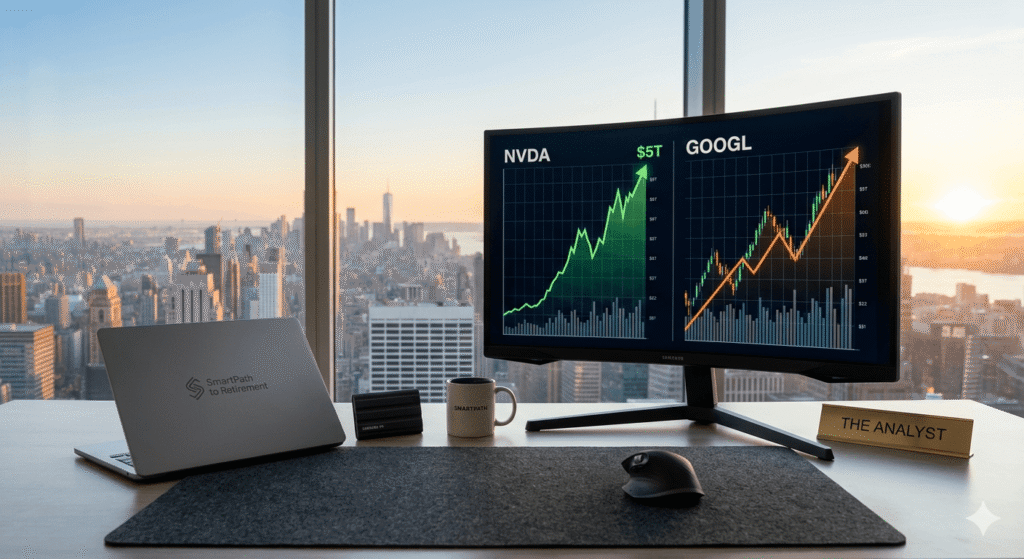
The financial landscape of 2026 is witnessing a titanic struggle. The era of Apple and Microsoft’s duopoly on the top spots is being challenged by two silicon and software giants: Nvidia (NVDA) and Alphabet (GOOGL). As both companies approach the historic $5 trillion market capitalization, the investment community is divided. Is the future built on the hardware that powers AI, or the ecosystem that delivers it to the masses?
Nvidia: The Indisputable King of AI Infrastructure
Nvidia’s journey to the top has been nothing short of legendary. As of May 2026, the company continues to defy skeptics who predicted an “AI bubble.” The recent launch of the Blackwell B200 series has set a new benchmark for data center efficiency, leading to a fresh all-time high in stock price. Although we have seen a healthy technical correction recently, this should be viewed as a consolidation phase rather than a reversal.
The secret to Nvidia’s longevity isn’t just the GPU; it’s CUDA. Over 5 million developers globally are now locked into Nvidia’s software stack, making it nearly impossible for large-scale enterprises to switch to competitors without massive disruption. Furthermore, Nvidia has aggressively expanded into Nvidia AI Enterprise, a software subscription model that provides recurring revenue—a move that significantly stabilizes their earnings quality.
Looking ahead to late 2026, the market is closely watching Nvidia’s move into Physical AI. By providing the “brains” for humanoid robots and autonomous factory fleets, Nvidia aims to ensure that even if the demand for LLMs (Large Language Models) peaks, the demand for industrial automation will keep their order books full for a decade.
Alphabet: The Renaissance of a Platform Giant
If 2024 was a year of doubt for Alphabet, 2026 is the year of its triumph. The stock has experienced a meteoric rise, largely because the company proved it could protect its search monopoly while dominating the AI application layer. Gemini 2.0 is now fully integrated into every Google service, from Workspace to Maps, creating a seamless “AI Agent” experience that competitors are struggling to replicate.
One of the most overlooked factors in Alphabet’s current valuation is its Vertical Integration. While other tech giants spend billions purchasing Nvidia chips, Alphabet has scaled its own TPU (Tensor Processing Unit) v6, which handles a significant portion of its internal AI workloads. This reduces capital expenditure and protects margins—a critical advantage in a high-interest-rate environment.
Furthermore, YouTube remains a crown jewel. In 2026, YouTube’s ad revenue has hit record highs, bolstered by AI-driven ad targeting that has increased ROI for small business owners by 40%. The “Sovereign AI” trend—where nations want their own localized AI models—has also benefited Google Cloud, which now boasts the widest global distribution of AI-optimized data centers.
Strategic Analysis: Infrastructure vs. Application
The current market correction in Nvidia and the surge in Alphabet represent a shift in investor sentiment. We are moving from the “Build Phase” to the “Deployment Phase.”
- The Bull Case for Nvidia: As long as there is a shortage of compute power, Nvidia is the world’s most powerful toll booth.
- The Bull Case for Alphabet: As AI becomes a utility, the company that owns the most user data and the most frequent touchpoints (Search, Android, YouTube) will capture the most long-term value.
For small business owners and individual investors managing their own SmartPath to Retirement, the volatility of these two stocks provides both risk and opportunity. Diversification between hardware and platform remains the most prudent strategy as we navigate the second half of the decade.
🛠️ The Investor’s Toolkit: Essentials for Success
To manage a high-growth portfolio and a digital business effectively, you need tools that match the speed of the market. Here are the two core essentials we recommend for 2026.
1. The Powerhouse for Market Analysis
Apple 2024 MacBook Air 13-inch Laptop with M3 chip
Whether you are running technical analysis on TradingView or managing your WordPress SEO, the M3 MacBook Air is the ultimate tool. Its silent, fanless design and incredible battery life mean you can stay connected to the markets from anywhere—whether it’s your office in Connecticut or a cafe in NYC. The 2024 model provides the perfect balance of performance and portability for the modern entrepreneur.
2. Secure Your Financial Legacy
SAMSUNG T7 Shield 2TB Portable SSD
In an era of digital uncertainty, physical backups of your most important data are vital. The T7 Shield offers lightning-fast speeds and IP65-rated water and dust resistance. It’s the perfect place to store your historical investment data, tax records, and blog media files securely. Never rely solely on the cloud; keep a physical copy of your “SmartPath” to ensure your retirement planning is never interrupted by a technical glitch.
Final Thoughts: The race to $5 trillion is a marathon, not a sprint. While Nvidia has the lead today, Alphabet’s massive ecosystem makes it a formidable challenger. Keep your tools sharp, your data secure, and your eyes on the long-term horizon.
Disclaimer: This article is for informational purposes only and does not constitute financial advice. Always consult with a professional before making investment decisions. This post contains affiliate links; we may earn a commission at no extra cost to you.