As an Amazon Associate, I earn from qualifying purchases.
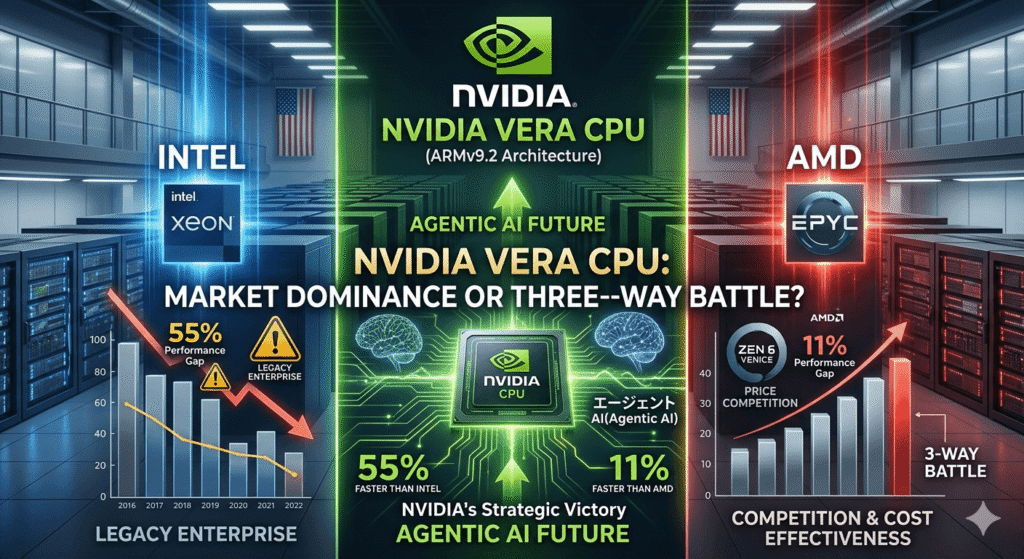
Nvidia (NASDAQ: NVDA) is already the undisputed king of the Artificial Intelligence (AI) GPU market. However, the tech giant is no longer satisfied with just dominating graphics cards. Nvidia has officially unleashed its next-generation independent data center CPU, codenamed “Vera.”
With the first independent benchmark results for the Vera CPU finally public, the entire semiconductor industry is in shock. The data shows that Nvidia’s new chip is faster than the flagship servers of both Intel and AMD.
This triggers a massive question for tech investors: Can Nvidia replicate its GPU monopoly in the CPU market? Let’s dive into a cold, objective analysis of Nvidia’s chances.
The Growth Drivers: Nvidia’s “Cheat Codes” for CPU Success
1. The Power of Bundled Ecosystems
Nvidia’s biggest advantage is not just selling a standalone CPU. Instead, they sell complete “AI platforms” like the Blackwell or upcoming Rubin architectures.
Big tech companies are practically begging to buy Nvidia’s AI GPUs. To get them, many hyper-scalers are forced to adopt Nvidia’s complete server infrastructure. Since the Vera CPU comes integrated directly into these high-end server systems, Nvidia essentially guarantees massive CPU sales without even trying. The company expects a staggering $20 billion in CPU revenue this year alone, immediately matching AMD’s entire annual revenue scale.
2. Tailor-Made for the “Agentic AI” Era
The AI landscape is shifting from simple chatbots to “Agentic AI.” Future AI models will not just answer questions; they will actively code, send emails, and verify data autonomously.
This operational shift requires incredibly fast sequential processing, which is the job of the CPU, not the GPU. Nvidia designed its custom “Olympus” core within the Vera CPU specifically to maximize Agentic AI workloads. According to recent Linux hardware benchmarks, Vera crushed Intel’s top-tier Xeon chip by 55% and outperformed AMD’s flagship by 11% in enterprise workloads.
3. Ultimate Energy Efficiency
Data centers are facing a massive crisis regarding electricity consumption and heat management. The Nvidia Vera CPU is built on the power-efficient Arm architecture.
By integrating ultra-fast LPDDR5X memory directly onto the chip, Nvidia eliminated the latency bottlenecks found in traditional Intel and AMD hardware. This allows the Vera CPU to deliver twice the energy efficiency of traditional x86 server chips. For tech giants looking to cut down massive electricity bills, switching to Nvidia is a no-brainer.
The Roadblocks: Why a 90% CPU Monopoly Is Unlikely
1. Fierce Resistance from AMD
While Nvidia outperformed Intel easily, its victory over AMD was much narrower, sitting at just an 11% performance lead. AMD is a highly resilient competitor.
Furthermore, AMD is preparing to launch its next-generation server chip, the Zen 6 “Venice” architecture, later this year. AMD will undoubtedly fight back with aggressive pricing and high core counts. Because the performance gap between Nvidia and AMD remains tight, AMD will not give up its hard-earned server market share easily.
2. The Legacy Software Inertia
For the past few decades, global enterprise software, operating systems, and legacy data centers have been optimized entirely for x86 architecture (Intel and AMD).
Moving to Nvidia’s Arm-based Vera CPU requires companies to rewrite software, reconfigure code, and run extensive compatibility tests. While new, dedicated AI data centers will adopt Vera immediately, traditional corporate servers will likely stick to x86 infrastructure due to convenience and cost.
3. Big Tech’s Fear of Dependence
Tech giants like Meta, Microsoft, and Amazon are deeply uncomfortable with Nvidia’s current GPU monopoly. Nvidia essentially dictates the pricing of the entire AI industry.
To prevent Nvidia from gaining the same absolute power over the CPU market, these tech companies are actively fighting back. They are either developing their own internal silicon or intentionally split-buying CPU chips from AMD and Intel to keep Nvidia’s influence in check.
Investor Verdict: A Three-Way Battle Looming
Nvidia will not achieve a 90% monopoly in the CPU market like it did with GPUs. The legacy x86 ecosystem is too deeply rooted, and competitors like AMD are too fast.
However, Nvidia is highly likely to conquer the most profitable sector: AI-specific data center CPUs. The market is rapidly transforming into a three-way battle: Nvidia dominating high-margin AI infrastructure, AMD leading in general-purpose and cost-effective servers, and Intel holding onto legacy enterprise infrastructure.
For investors, this CPU expansion secures a powerful new recurring revenue stream for Nvidia, solidifying its status as an irreplaceable tech powerhouse for years to come.
Disclaimer: I am not a licensed financial advisor, broker, or tax professional. The content on this blog is for informational and educational purposes only and reflects my personal journey and research. Please consult with a qualified professional before making any financial decisions.