As an Amazon Associate, I earn from qualifying purchases.
There is a popular belief in the investment world that “more is better.” If you hold 50 stocks, you are safer than if you hold 5. If you hold 100, you are safer still. But in my 10 years of running a business, I have learned that complexity is rarely your friend. In fact, when it comes to investing, there is a very real danger called “Diworsification”—the act of spreading your capital so thin that you effectively neutralize your potential for meaningful growth.
I have spent a long time finding my own “sweet spot.” I’ve realized that for me, as a business owner who values focus, clarity, and control, the perfect number of assets to manage is exactly 10.
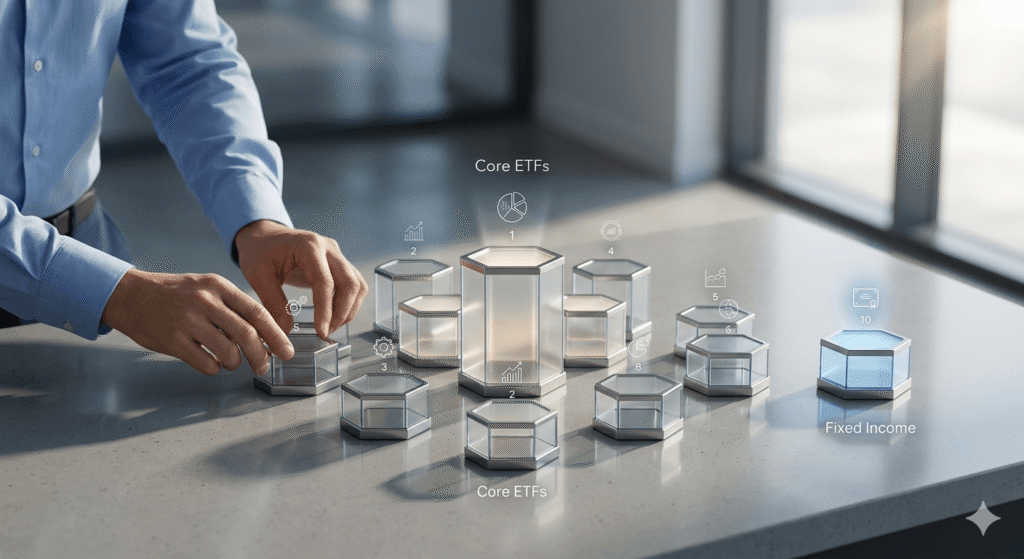
Currently, my portfolio is structured as a 3+1+6 system: 3 foundational ETFs, 1 stabilizing bond fund, and 6 high-conviction individual stocks. Here is why this 10-asset approach is the backbone of my 17-year retirement plan.
Why 10? The Power of “Manageable Conviction”
Why 10? Why not 5 or 50? For me, 10 is the number of maximum effective focus.
If you own 50 stocks, you are no longer an investor; you are a mutual fund manager. You cannot possibly track the quarterly earnings, the competitive landscape, and the operational changes of 50 different companies while also running your own business. When you hold too many assets, you become a passive observer of your own wealth.
By limiting myself to 10 assets, I am forced to be selective. I cannot buy every “hot” stock I see on YouTube. I must ask myself: “Is this asset worth taking up one of my 10 slots?” This forces me to maintain a higher standard of quality. It keeps my conviction high. When you own only 10 things, you take the time to actually understand what you own.
The Structure of My 10-Asset Portfolio
My portfolio is not a random collection of tickers. It is a hierarchy, designed to balance growth with preservation.
| Asset Type | Quantity | Purpose |
|---|---|---|
| Core ETFs | 3 | Market-wide exposure and sector growth |
| Fixed Income | 1 | Volatility dampener and risk reduction |
| Satellite Stocks | 6 | High-conviction growth and business analysis |
| Total | 10 | The “Sweet Spot” for Control |
Export to Sheets
1. The Core (3 ETFs)
These are my “business bedrock.” They cover the S&P 500, the Nasdaq-100, and dividend stability. They require the least amount of “analysis time” but provide the most reliable long-term returns. They are the engine that drives my wealth forward while I sleep.
2. The Ballast (1 Bond Fund)
Even the best businesses need a cash reserve. My bond fund is the financial “cash reserve” of my portfolio. It doesn’t provide the explosive growth of tech stocks, but it provides peace of mind. During market crashes, this single bond asset acts as a stabilizer, preventing my total portfolio from swinging as violently as the broader market.
3. The Satellite (6 Individual Stocks)
This is where I get to be the “CEO of my wealth.” These 6 stocks are businesses that I have personally researched, analyzed, and deemed worthy of my capital. I apply the same lens to these companies that I apply to my own business: Do they have a competitive advantage? Is their leadership sound? Will they still be relevant in 10 years? Holding 6 stocks allows me to benefit from “stock picking” without falling into the trap of over-diversification.
The Business Owner’s Advantage: “Depth Over Width”
In my business, I don’t try to offer 1,000 different products. I focus on the few that provide the most value to my customers. I focus on depth.
When I apply this to my portfolio, I stop worrying about “missing out” on the stocks I don’t own. It doesn’t matter if a stock I don’t own goes up 20% tomorrow. What matters is that my 10 chosen assets are performing according to my long-term strategy.
By keeping my list short, I am able to:
- Rebalance with ease: If the tech sector (via my ETFs) grows too large, I can easily trim it and move capital into my 6 stocks or my bond fund.
- Monitor performance: I can read the news and earnings for these 10 assets in a few hours a month.
- Stay disciplined: I don’t get distracted by the noise of the market because my “dance card” is already full.
Common Concerns About Concentrated Diversification
Q: Is 10 assets enough to be truly diversified? A: Yes, if the assets are uncorrelated. If you own 10 different oil stocks, you aren’t diversified. But if you own 3 broad ETFs, a bond fund, and 6 stocks across different sectors (Technology, Healthcare, Consumer Goods, etc.), you are capturing market growth while limiting your downside.
Q: What if one of my 6 stocks fails? A: That is the risk of the “Satellite” strategy. But remember, the 3 ETFs make up the majority of my portfolio. Even if one of my 6 individual stocks goes to zero (which, with proper research, shouldn’t happen), the impact on my total retirement goal is limited. My Core ETFs provide the safety net.
Q: Should everyone aim for 10? A: Not necessarily. The “perfect” number of assets is the number you can stay disciplined with. If managing 10 assets causes you stress, hold 5. If you love research and want to manage 15, do that. But find the number that allows you to remain the CEO of your own strategy, rather than a passenger in someone else’s.
The Bottom Line: Be the Architect, Not the Collector
Investment portfolios are not Pokémon collections—you don’t win by “catching them all.” You win by owning a set of high-quality assets that, when working together, create a system of compounding growth.
My 10-asset strategy isn’t about arbitrary rules; it’s about focus. It’s about being an architect of my future rather than a collector of tickers. As I look toward my retirement at 67, I feel a deep sense of calm knowing exactly what I own, why I own it, and how it serves my goals.
What about you? Do you prefer a wide, “index-everything” approach, or do you like to keep your portfolio focused on a specific number of high-conviction assets? Share your strategy in the comments below—I’d love to hear how you find your “sweet spot.”
Disclaimer: I am not a financial advisor. This post reflects my personal investment philosophy and strategy. All investments carry risk, and past performance is not indicative of future results. Please conduct your own research before making financial decisions.