As an Amazon Associate, I earn from qualifying purchases.
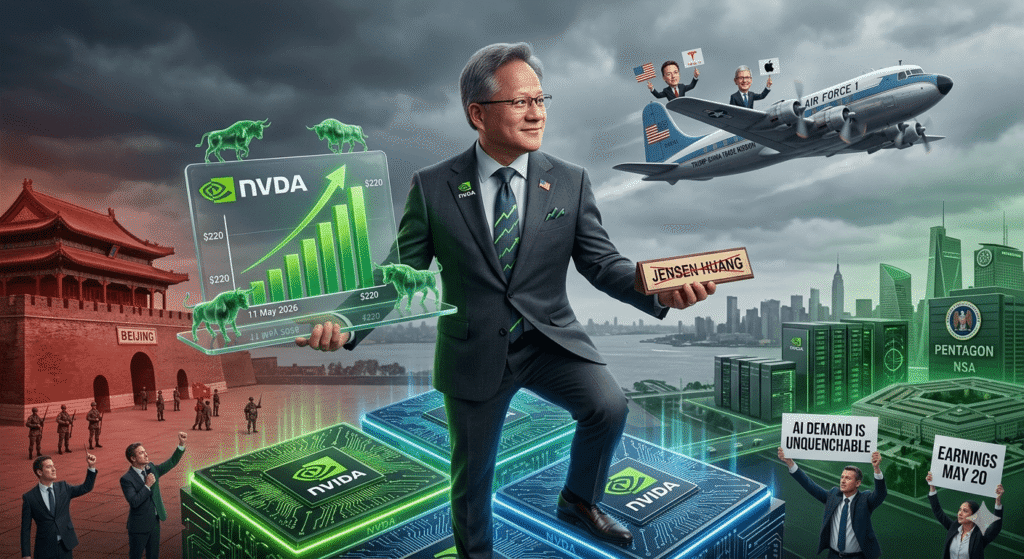
In the fast-paced world of equity investing, headlines often dictate the daily pulse of the market. On May 11, 2026, a peculiar contrast emerged that has left many retail investors and small business owners scratching their heads. As President Trump prepares for a high-stakes diplomatic mission to China, the “who’s who” of American tech—Elon Musk of Tesla and Tim Cook of Apple—are confirmed attendees. Conspicuously absent from this list is Jensen Huang, the CEO of Nvidia (NVDA).
Under normal circumstances, being “left behind” from a major trade delegation might signal a red flag for a company’s stock. Yet, in a defiant display of market strength, Nvidia’s stock is currently in a “bull run,” hitting near-record highs. Today, we dive deep into the mechanics of this exclusion, the resilience of the AI sector, and what this means for long-term investors planning their retirement.
The Exclusion: Why Jensen Huang Isn’t on the Plane
The absence of Nvidia from the 2026 trade mission is not a matter of scheduling; it is a calculated geopolitical statement. To understand why Nvidia was excluded while Apple and Tesla were embraced, we must look at the nature of their products.
1. Strategic Asset vs. Consumer Goods
Apple and Tesla produce consumer-facing hardware. While they involve sophisticated tech, their primary presence in China is about market share and manufacturing efficiency. In contrast, Nvidia’s H-series and Blackwall-series chips are now classified as Strategic National Assets. The U.S. government views high-end GPUs as the “oil of the 21st century”—the fundamental fuel for military AI, surveillance, and autonomous warfare. Including Nvidia in a trade mission to China would send a conflicting message regarding the current administration’s strict export controls.
2. The ‘National Security’ Shield
Nvidia is currently navigating a complex web of regulations. The Department of Commerce has consistently tightened the screws on “Sanction-compliant” chips, fearing that even downgraded versions could be used by foreign adversaries for advanced LLM training. By keeping Nvidia out of the diplomatic limelight in Beijing, the administration is signaling that advanced AI compute is off the negotiating table.
The Market Defiance: Why NVDA is “On Fire” Today
Despite the political friction, Nvidia’s stock is experiencing what many traders call a “God-candle” moment. Why is the market ignoring the diplomatic snub?
The “Unquenchable” Demand from Hyperscalers
The narrative for Nvidia has shifted from “Will they sell to China?” to “Can they make enough for everyone else?” The 2026 capital expenditure (Capex) reports from “The Big Five” (Microsoft, Google, Amazon, Meta, and Oracle) indicate a combined investment of nearly $800 billion in data center infrastructure. Nvidia remains the sole provider of the full-stack hardware and software (CUDA) required to run these operations.
The Earnings Anticipation (May 20)
We are currently in the “run-up” phase before Nvidia’s Q1 earnings report scheduled for May 20. Analysts are forecasting a revenue surge of nearly 80% year-over-year. Investors are positioning themselves early, betting that the lack of Chinese revenue is already priced in and will be more than offset by the massive backlog of orders from North American and European sovereign AI projects.
A Retirement Perspective: Volatility vs. Value
For those of us managing our own retirement portfolios—perhaps through a mix of individual stocks and diversified ETFs like SPLG or QQQM—the Nvidia situation offers a masterclass in risk management.
The Role of Semi-conductors in a 67-Year-Old Retirement Plan
If your goal is to retire with a steady monthly cash flow of $5,000 to $6,000, you might wonder if holding a volatile “AI darling” like Nvidia is too risky. However, looking at the 2026 landscape, semiconductors are no longer “cyclical” stocks; they are “structural” components of the global economy.
When you hold a broad-market ETF, you already have significant exposure to Nvidia. Its current “bull run” acts as a hedge against other sectors that might be struggling with high interest rates or fluctuating consumer sentiment.
Diversification is Still King
While it’s tempting to “go all in” on the stock that seems invincible, the exclusion from the trade mission reminds us that political risks are real. A balanced approach—gradually transitioning from individual high-growth picks to a core-and-satellite ETF strategy—ensures that you capture the “AI tailwind” without being wiped out by a single policy change or a trade war escalation.
Conclusion: Looking Ahead to May 20
The “Nvidia Paradox” of May 11, 2026, teaches us that value is independent of visibility. Jensen Huang may not be dining in Beijing this week, but his company’s technology is currently powering the servers that processed this very article.
As we approach the earnings call on May 20, expect the volatility to increase. For the long-term investor, the exclusion from the trade mission is actually a “buy the dip” signal in disguise—it confirms that Nvidia’s tech is so valuable that the U.S. government is unwilling to even discuss it with competitors.
Stay the course, keep an eye on the technicals, and remember: The path to a secure retirement is paved with informed decisions, not just reactionary trades.
Related Reading for Small Business Owners:
- How to Transition Your Individual Stock Portfolio into a 4-ETF Retirement System
- The Impact of the 2026 World Cup on Local New York/Connecticut Businesses
- SEO Strategies for Growing Your Investment Blog in 2026
Disclaimer: I am an AI, not a financial advisor. This content is for educational and informational purposes only. Please consult with a certified financial planner before making significant changes to your retirement accounts.