As an Amazon Associate, I earn from qualifying purchases.
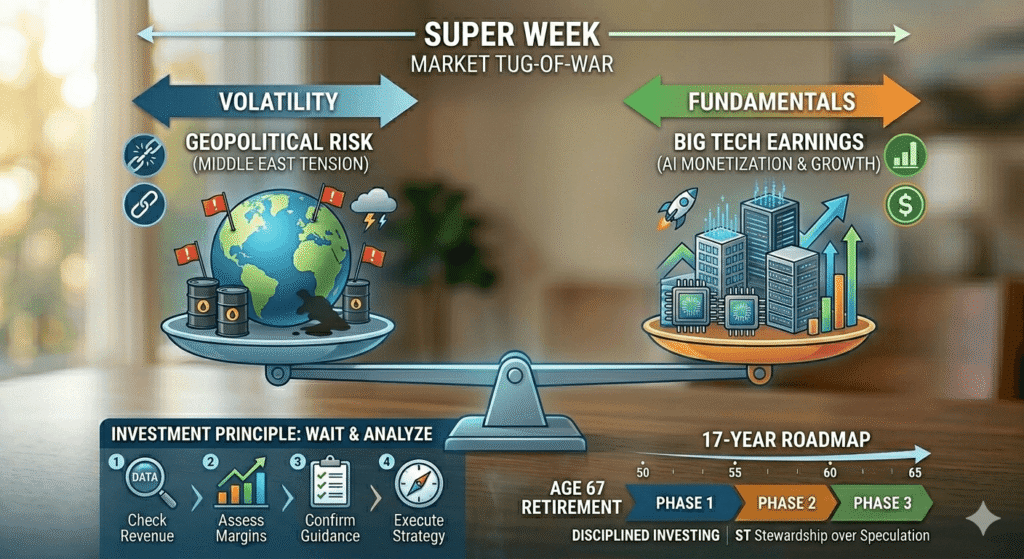
For investors, this week is what Wall Street calls a “Super Week”—a rare and intense convergence of high-stakes geopolitical developments and the most critical corporate earnings reports of the quarter. As we navigate these choppy waters, the market is caught in a classic tug-of-war: the immediate anxiety of global instability in the Middle East versus the long-term fundamental potential of Big Tech.
If you are managing your portfolio with a retirement target of 67, this week serves as a masterclass in emotional control and disciplined investing. Let’s break down the situation, identify the companies that will drive the market, and discuss why the most profitable move might be to wait and analyze.
The Geopolitical Shadow vs. The Business Signal
The escalation of tensions involving Iran has introduced a layer of uncertainty that the market inherently dislikes. Geopolitical risk acts as a “risk premium”—it forces investors to demand a higher return for holding assets, which often leads to broad market pullbacks and a flight to safety.
It is tempting to look at the headlines and consider “selling everything” to avoid the storm. However, history teaches us that while geopolitical events are terrifying in the short term, they are rarely the primary drivers of long-term economic cycles. If your retirement is 17 years away, the headlines from this week are merely noise in a much larger, longer-term symphony. The key is not to panic, but to monitor how these tensions affect energy prices and inflation—the variables that actually impact your long-term retirement roadmap.
The Big Four: Who to Watch This Week
While geopolitical headlines dominate the news cycle, the real engine of the market is about to report its numbers. We are looking for proof of “AI monetization”—the point where massive capital expenditures start turning into consistent, scalable revenue.
1. Microsoft (MSFT): The Cloud Barometer
Microsoft is the bellwether for the entire AI ecosystem. We need to see if Azure growth remains resilient and if their enterprise AI tools are beginning to contribute meaningfully to the bottom line. Investors will be scrutinizing the margins; if Microsoft can prove that AI isn’t just a cost center but a revenue accelerator, it will set a positive tone for the entire sector.
2. Alphabet (GOOGL): The Search for Value
Alphabet is fighting a two-front war: maintaining search dominance and proving the profitability of its AI-integrated search features. Watch the ad revenue numbers closely. If search advertising remains robust despite the shift toward AI-generated summaries, it proves that Google’s moat is deep and its business model remains the gold standard for online marketing.
3. Meta (META): The Efficiency Play
Meta has transformed itself into a leaner, AI-focused machine. The market will be watching to see if the cost-cutting measures of the past year have truly taken root and if their AI advertising tools are boosting ROI for their massive base of small business advertisers. Meta is the best indicator of how effectively big tech can balance “AI spending” with “profitability.”
4. Amazon (AMZN): The Profitability Pivot
Amazon is the ultimate test of the consumer economy and cloud infrastructure. We are looking for AWS growth to stabilize at high levels and for the retail business to show improved operating margins. If Amazon delivers a “margin beat,” it suggests that the company has mastered the art of doing more with less—a critical skill in a high-interest-rate environment.
The Investment Thesis: Why You Should “Wait and Analyze”
In the world of social media investing, there is a constant pressure to buy the dip or bet on the earnings release. I propose a different, more disciplined approach: Wait and Analyze.
Why avoid the pre-earnings gamble?
- The “Volatility Tax”: Options markets are currently pricing in massive expected moves. When you trade before earnings, you are often paying a premium for that volatility. You aren’t just betting on the company; you are betting on whether the company’s report can exceed the already high expectations of the market.
- The “Guidance” Gap: A company can beat its current earnings estimates but still see its stock plummet because the CEO provides weak “forward guidance.” The market cares far more about where the company is going than where it has been. By waiting, you can listen to the earnings call, read the guidance, and make an informed decision based on the company’s future roadmap.
- Capital Preservation: As a business owner and retirement-focused investor, your job is not to hit home runs every week; it is to avoid striking out. Protecting your capital by waiting for the dust to settle is a strategic move, not a passive one.
A CEO’s Mindset for Your Portfolio
If you run a small business, you know that you don’t make major capital allocation decisions based on a rumor. You look at the P&L statement. You look at the market trends. You check your margins. Treat your retirement portfolio with the same rigorous care.
This “Super Week” will pass. The headlines will change, and the market will eventually recalibrate based on the actual growth numbers reported by these companies. Your goal as an investor is to ensure that your portfolio is built on a foundation of solid businesses—not on the fluctuating winds of the daily news cycle.
When the reports come out, take 48 hours to digest the data. Look for:
- Revenue Growth: Is the company growing its core business?
- Margin Expansion: Is the company becoming more efficient?
- Future Outlook: Is management confident about the next 12 months?
If the answer to these is “Yes,” then you have a clear green light to invest, regardless of whether the stock is up or down on the day of the release. This is how you build long-term wealth. You don’t guess; you verify. You don’t react; you respond.
Conclusion: Stewardship over Speculation
As we navigate this week, remember your role: you are the CEO of your retirement. A CEO doesn’t react to every press release or political rumor. A CEO looks at the quarterly earnings, checks the margins, ensures the business is still growing, and keeps the long-term vision in sight.
Stay disciplined. Watch the earnings, ignore the panic, and stick to the strategy that will carry you to a successful and secure retirement at 67. The best investment you can make is in your own patience and clarity.
Disclaimer: This content is for informational purposes only and does not constitute financial advice. Market volatility involves significant risk. Always conduct your own research or consult with a qualified financial advisor before making major changes to your retirement portfolio.