As an Amazon Associate, I earn from qualifying purchases.
For the past year, if you asked any investor about the semiconductor industry, they would answer with one acronym: GPU. The explosive growth of AI training models turned Nvidia into a household name and sent the market into a frenzy of GPU accumulation.
But as any seasoned investor knows, the market is a pendulum. Recently, we have witnessed a significant shift. The spotlight is moving away from the narrow focus on GPUs and squarely onto the CPU. This isn’t just a market fluctuation; it represents a fundamental change in how we process the next generation of computing.
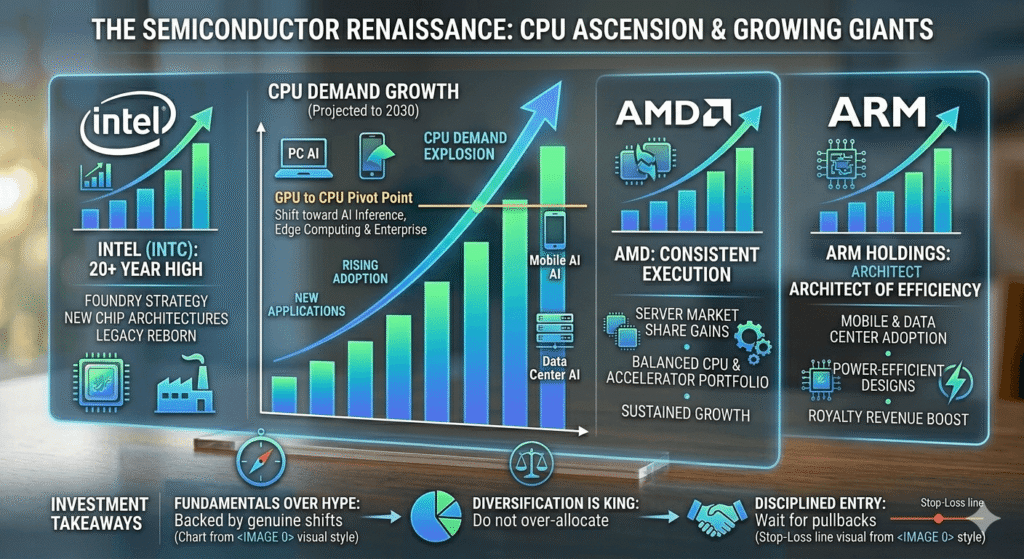
With Intel hitting a new high after two decades, and companies like AMD and ARM Holdings seeing double-digit growth, it is time to look at why the “CPU Renaissance” is the story of the quarter.
From Training to Inference: The CPU’s Comeback
The initial wave of the AI boom was driven by training—teaching massive models to understand data. That requires heavy-duty GPUs. However, we are now entering the phase of inference—deploying those AI capabilities into PCs, enterprise servers, and edge devices.
In this phase, raw throughput is not enough. You need efficiency, logic, and integration—the traditional strongholds of the CPU. As AI features become embedded in operating systems, business software, and mobile devices, the demand for high-performance CPUs has exploded. The market has realized that you cannot run the AI future on GPUs alone.
The Titans of the New Era
The stock performance across the semiconductor sector reflects this shift. We are seeing a refreshing divergence where Intel, AMD, and ARM are all capturing investor interest for different reasons.
1. Intel: The “Comeback Kid” at a 20-Year High
Perhaps the most stunning story in the semiconductor space is Intel. After years of being written off by analysts, the company has broken through a significant resistance level, hitting a new high after 20 years.
This isn’t just about market sentiment; it is about the “Foundry” strategy. By opening its manufacturing capabilities to others and doubling down on its new chip architecture, Intel has signaled that it is no longer the legacy giant of the past, but a necessary player in the future of silicon. For long-term investors, seeing Intel reach a new peak is a powerful reminder that in the tech world, the “old guard” is never truly out of the fight.
2. AMD: Consistent Execution
While Intel chases the turnaround, AMD has continued to execute with precision. AMD’s ability to capture server market share while maintaining a strong foothold in the consumer PC market has kept it in the double-digit growth club. AMD has proven that it can thrive in a world that needs both powerful CPUs and high-end AI accelerators. Its stock performance reflects a market that values consistent growth over speculative hype.
3. ARM Holdings: The Architecture of Efficiency
If Intel and AMD are the masters of the x86 world, ARM Holdings is the architect of the mobile and efficient computing world. ARM’s business model—licensing its architecture rather than manufacturing chips—makes it a unique player. As data centers look for power-efficient alternatives to traditional processors, ARM’s design has become the gold standard. The stock’s double-digit rise is a testament to the fact that efficiency is becoming just as valuable as raw power.
What This Means for Your Portfolio
If you are reading this on Smart Path to Retire, you are likely looking at these shifts not just for quick profits, but through the lens of long-term wealth building.
When you see Intel hitting new highs or ARM soaring, the temptation is to jump in immediately. However, remember that the semiconductor sector is notoriously cyclical.
- Look for Fundamentals, Not Hype: The jump in stock prices for Intel, AMD, and ARM is backed by a genuine shift in CPU demand. This is not the same as a speculative bubble. That makes it more sustainable.
- Diversification is Still King: Even if the CPU sector is hot, don’t allocate your entire retirement portfolio to semiconductors. The “GPU to CPU” shift is a long-term trend, not a one-week event.
- The “Wait and See” Approach: If you missed the double-digit run-up, don’t chase the candle. Watch for pullbacks. Quality semiconductor companies tend to have long growth runways, and there will be entry points for disciplined investors.
The Road Ahead
The semiconductor industry is maturing. The transition from “GPU-mania” to a balanced ecosystem of GPU and CPU power is a healthy sign for the industry. It means AI is moving from the lab to our laptops, our factories, and our daily business operations.
For a business owner or a retirement-focused investor, this means the technology is becoming part of the “real economy.” Intel’s resurgence after 20 years is a symbol of this maturity—the industry is evolving, and those who adapt are being rewarded.
As we look toward 67 and beyond, our investment strategy should reflect this maturity. We aren’t just betting on chips anymore; we are betting on the infrastructure that will run the global economy for the next two decades.
Disclaimer: This content is for informational purposes only and does not constitute financial advice. The semiconductor sector is volatile. Always conduct your own research or consult with a qualified financial advisor before making investment decisions.