As an Amazon Associate, I earn from qualifying purchases.
A massive shift just happened in the semiconductor industry.
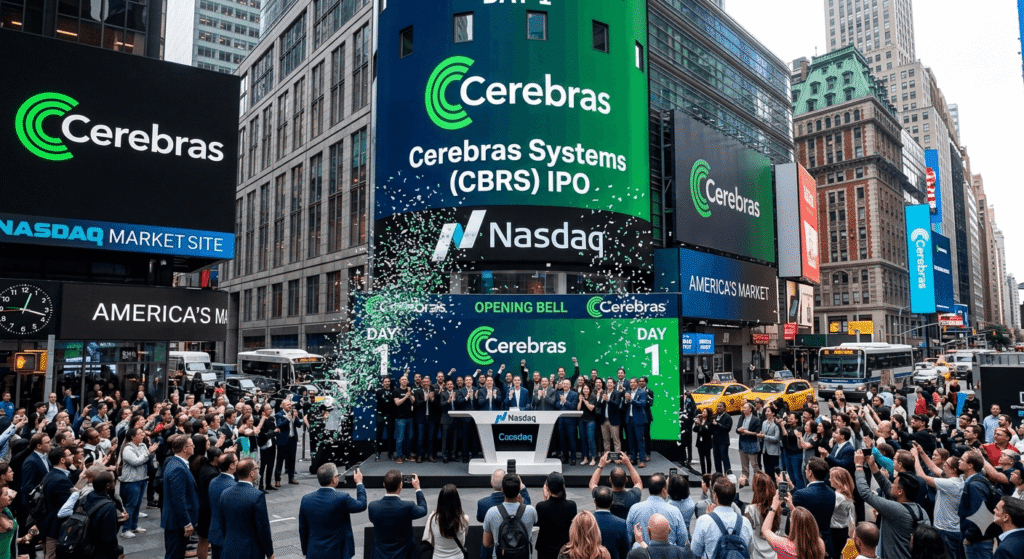
Cerebras Systems successfully went public on Nasdaq on May 14, 2026.
The IPO price was set at $185 per share.
Trading opened at an astonishing $350.
The stock closed its first day at $311.07.
This represents a spectacular 68% first-day surge.
The company’s market capitalization reached nearly $67 billion instantly.
It is officially the largest tech IPO of 2026 so far.
Retail investors are asking a critical question today.
Can Cerebras truly challenge Nvidia’s absolute market monopoly?
What does this mean for global memory manufacturers?
Let us look closely at this semiconductor revolution.
1. What is Cerebras Systems (CBRS)?
Cerebras is a unique hardware startup founded in 2015.
They design specialized processors for commercial AI applications.
Their core product is the Wafer-Scale Engine (WSE-3).
Normal microchips are cut from a silicon wafer.
Cerebras does something completely different and radical.
They use the entire wafer as one massive chip.
It is 58 times larger than Nvidia’s Blackwell GPU.
This giant chip offers mind-blowing AI computing processing speeds.
2. The Direct Impact on Nvidia (NVDA)
Can Cerebras defeat Nvidia anytime soon?
The short answer is no, but threats are growing.
Nvidia still controls over 90% of the AI market.
However, Cerebras is capturing Nvidia’s most valuable customers.
Cerebras recently signed a $20 billion deal with OpenAI.
OpenAI will use Cerebras servers for the next three years.
Amazon and Meta are also collaborating with Cerebras now.
These tech giants desperately want an alternative to Nvidia.
Furthermore, Cerebras dominates in AI inference speeds.
It runs large language models 15 times faster than traditional GPUs.
It also reduces operating power consumption significantly.
Nvidia’s pricing power might weaken because of this.
3. The Shockwave to the Big 3 Memory Makers
This IPO brings unexpected bad news for traditional memory companies.
Samsung, SK Hynix, and Micron are watching closely.
Their record profits currently depend entirely on HBM sales.
HBM is high-bandwidth memory stacked next to GPUs.
But here is the catch.
Cerebras does not use HBM memory at all.
Instead, they embed fast SRAM directly inside the giant wafer.
This bypasses the traditional HBM memory bottleneck completely.
📉 SK Hynix
SK Hynix is currently the leading HBM supplier.
If tech companies choose Cerebras, HBM demand decreases.
Therefore, SK Hynix faces immediate long-term structural valuation risks.
⚖️ Samsung Electronics
Samsung is aggressively expanding its new HBM production lines.
A shift toward SRAM architecture could hurt their investments.
However, Samsung can manufacture advanced SRAM via its foundry.
🇺🇸 Micron Technology
Micron will also experience lower HBM market growth rates.
But Cerebras systems still require large external DDR5 system memory.
Micron can offset losses through US-based server chip supply.
💡 Investor Action Plan: How to Deal with It
The AI semiconductor landscape is diversifying rapidly.
We must adjust our long-term portfolios accordingly.
- Don’t Chase the Hype: Cerebras stock is highly volatile right now. Wait for the initial IPO frenzy to calm down.
- Monitor Memory Portfolios: Do not rely solely on HBM growth stories. Ensure your tech ETFs include diverse hardware companies.
- Nvidia is Still King: Nvidia’s massive software ecosystem keeps it safe for now. But keep an eye on profit margin changes.
Stay patient and watch the next quarterly earnings reports.
The semiconductor war is just getting started.
Disclaimer: I am not a financial advisor. This post reflects my personal investment philosophy. All investments carry risk, and past performance is not indicative of future results. Please conduct your own research before making any financial decisions.